

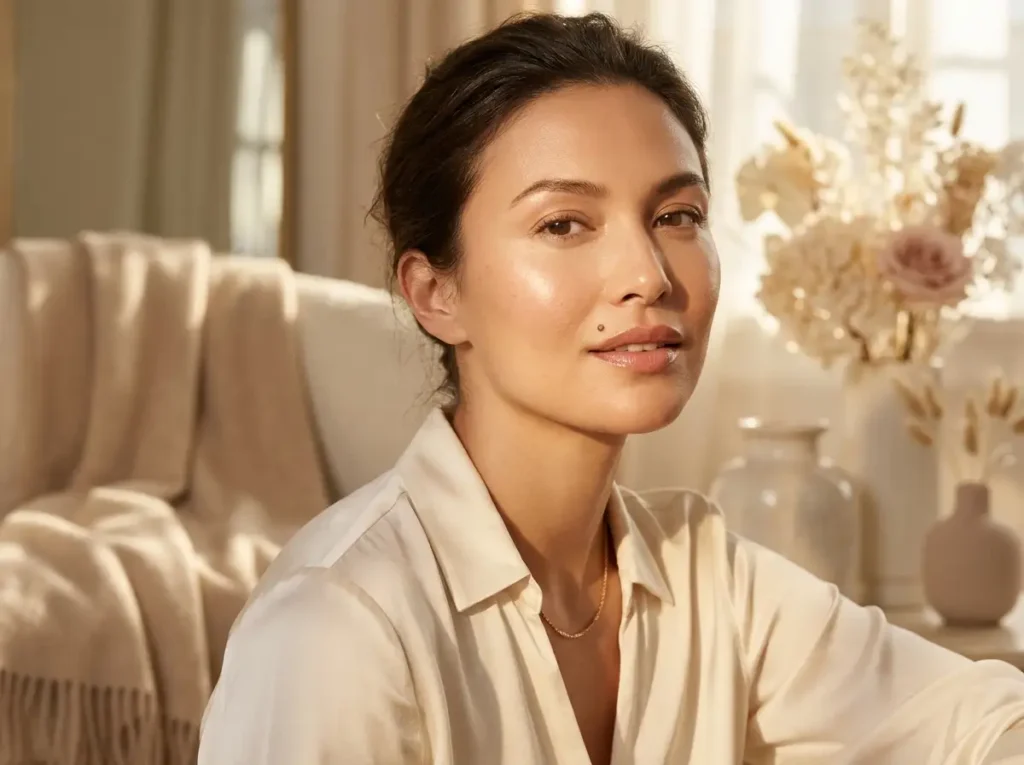
Type “what is a beauty mark” into Google and you walk away with more questions than you started with. Is it a mole? A freckle? Something lucky? A little kiss from the universe landing right on your cheek? The truth sits somewhere in the middle of skin science, old superstition, and the simple fact that humans have always found certain marks beautiful.
A beauty mark is, in plain terms, a small dark spot on the skin that happens to land in a flattering spot, usually on the face. Think Marilyn Monroe’s cheek or Cindy Crawford above her lip. In simple terms, what are beauty marks? They’re small pigmented spots that many people see as attractive facial features. Medically it’s almost always a mole, but “mole” never sounded romantic, so we called the pretty ones beauty marks instead.
In this guide we’ll cover everything in one place: what beauty marks actually are, how they differ from moles and freckles, what causes them, what they’ve meant across cultures, the spiritual meanings people attach to each location, whether they fade on their own, and how removal works if you ever want one gone. We’ll also flag the warning signs that matter, because a mark on your face deserves the same attention as any other spot on your body.
What Is a Beauty Mark, Really?
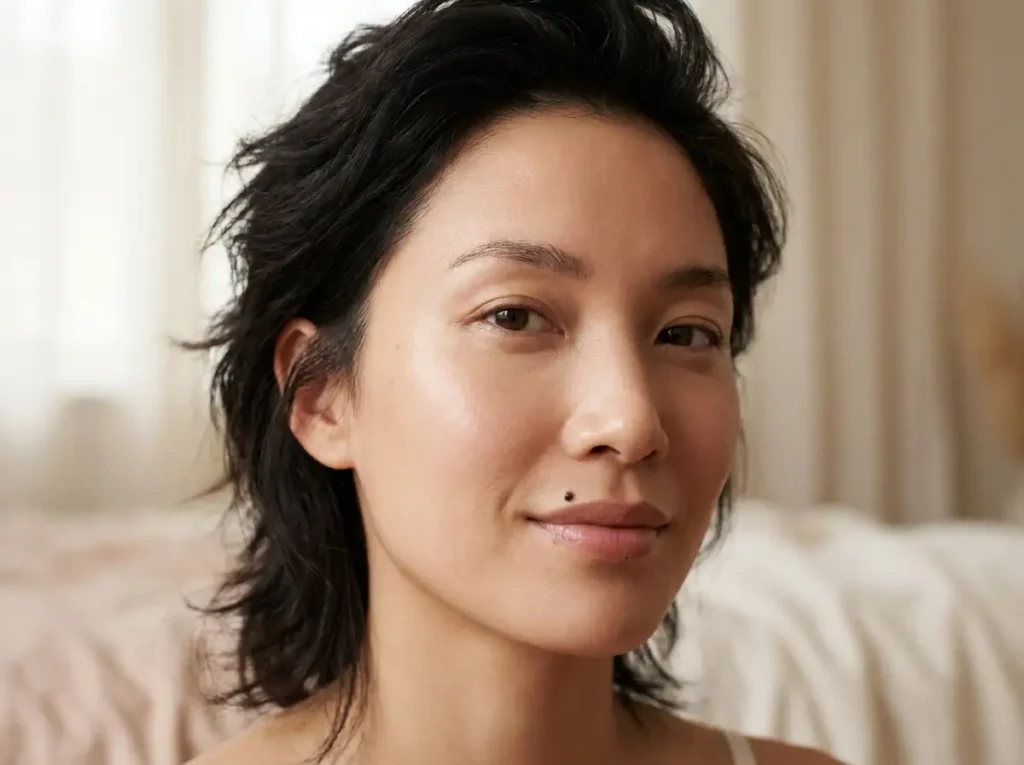
Dermatologists use the word nevus for what most of us call a mole — a little cluster of pigment-producing cells called melanocytes. A beauty mark is simply a mole that meets a few aesthetic cues: it’s small (often under half a centimetre), round or slightly oval, evenly coloured from light brown to almost black, and sitting somewhere that draws the eye in a pleasing way.
So here’s the honest answer to the question everyone asks: all beauty marks are moles, but not all moles read as beauty marks. So if you’re wondering are beauty marks moles, the answer is usually yes from a medical perspective. The label has nothing to do with biology and everything to do with placement and symmetry. A mole near the lips or on the cheekbone gets adored; the same mole on your back rarely gets a second glance.
Some beauty marks are present from birth. Many show up later, often in the teenage and young-adult years, when hormones and sun exposure nudge melanocytes to gather. Once they settle in, they tend to stay put for years with the same colour, border, and size.
And yes, some beauty marks aren’t natural at all. People have drawn them on with makeup pencils or had tiny cosmetic tattoos done for centuries. They carry no medical meaning, but they prove a lovely point: a well-placed spot can change the whole balance of a face.
Beauty Marks vs Moles vs Freckles: How to Tell Them Apart
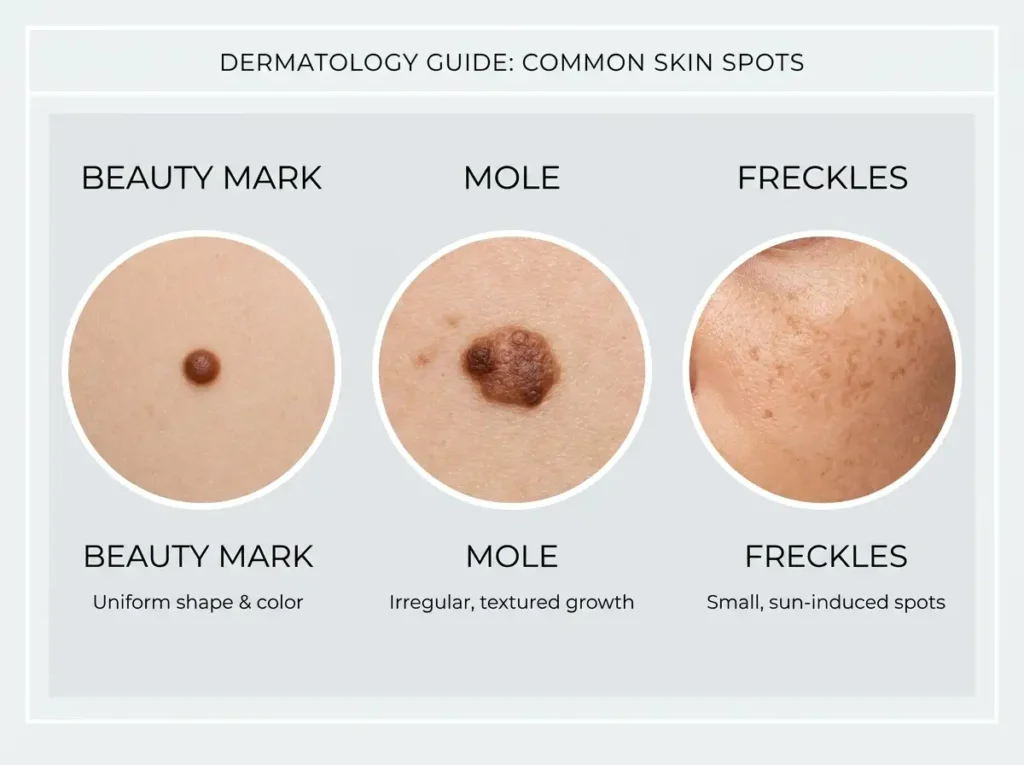
This is where most people get tangled up, so let’s make it simple. The three are related but not identical, and the differences actually matter for your skin health.
| Feature | Beauty Mark / Mole | Freckle |
| What causes it | A cluster of melanocytes (pigment cells) grouped together | Extra melanin from sun exposure — not extra cells |
| Shape & edges | Round or oval, fairly defined border | Small, flat, softer and less defined |
| Colour change | Usually stays the same year-round | Darkens in summer, fades in winter |
| Texture | Flat or slightly raised | Always flat |
| Needs monitoring? | Yes — watch for changes | Rarely, but sun protection still matters |
There’s one more lookalike worth naming. Age spots (also called lentigines or sun spots) are flat, uniform brown patches tied to years of sun exposure. They’re usually larger and more spread out than a classic beauty mark. If a spot is creeping outward and tied to sun damage, it’s probably an age spot, not a beauty mark. A consistent daily skin care routine with sunscreen is the single best way to keep new ones from forming.
What Causes Beauty Marks?

Beauty marks form when melanocytes grow in clusters instead of spreading evenly through the skin. That clustering creates a concentrated little dot of pigment — the spot you see. A few things drive this:
• Genetics. If your parents had beauty marks, you’re more likely to have them too. The number and placement often run in families.
• Sun exposure. UV light doesn’t create moles out of nowhere, but it ramps up pigment activity and can make existing marks darker or more noticeable.
• Hormones. Puberty and pregnancy both trigger hormonal shifts that can darken existing marks or bring new ones to the surface.
• Age. Most people accumulate moles through their twenties and thirties, then the count tends to level off.
Because sun plays such a big role, protecting your skin pays off twice — it keeps your existing marks from darkening and lowers your overall skin-cancer risk. If you’re not sure where to start, a Korean-style sun protection routine makes daily SPF feel effortless, and there are great sunscreens formulated for acne-prone skin if heavier formulas usually break you out.
Beauty Marks Through History: From Roman Omens to Hollywood Glamour
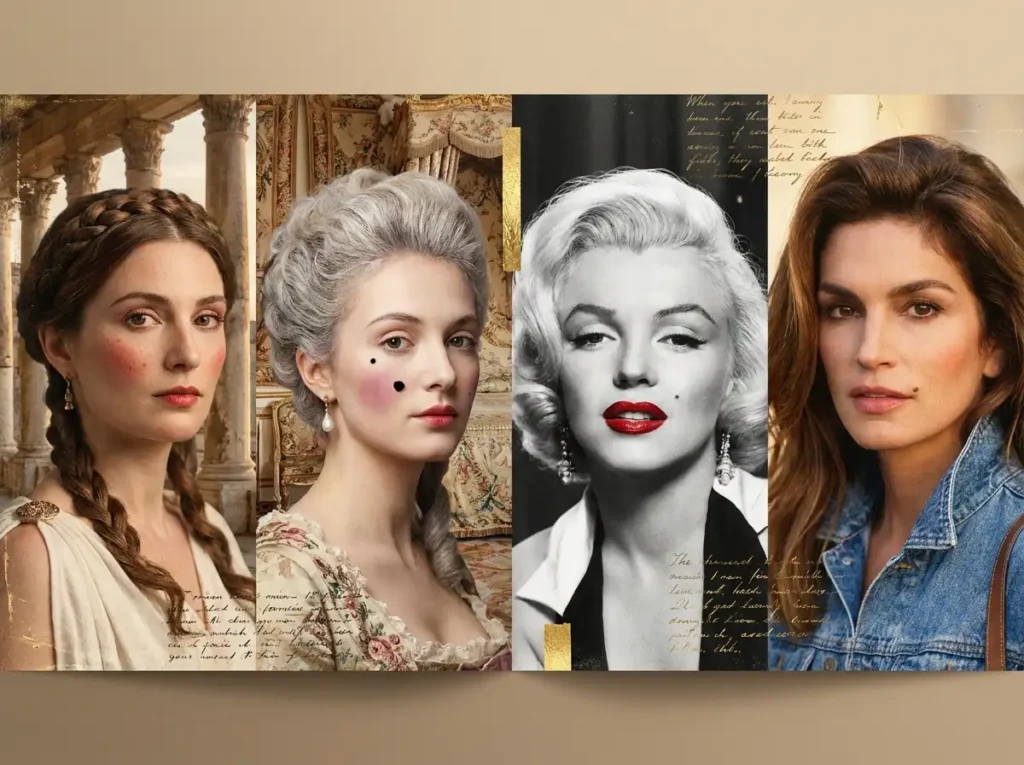
We didn’t always agree on what a beauty mark meant, but we’ve been fascinated by them for a very long time.
In ancient Greece and Rome, natural beauty marks were often read as signs of good fortune. By 18th-century France, aristocrats took it further and wore artificial spots called mouches — tiny patches placed deliberately on the face to flirt, signal status, or even hint at political loyalty. Where you stuck your mouche actually said something.
Then came Hollywood’s golden age, and beauty marks went from quirk to icon. Marilyn Monroe made the cheek mark a symbol of glamour. Cindy Crawford turned what early agents called a flaw into her signature. Eva Mendes, Robert De Niro, and plenty of others showed the look works on every face and every skin tone. These were the people who taught a few generations that a so-called imperfection could be the most memorable thing about a face. Across many cultures, beauty marks meaning for women has often been linked with charm, femininity, confidence, and individuality.
That shift still shapes how we see ourselves today. The same spot that once got concealed under heavy makeup is now something people ask their dermatologist to keep. If you’re curious about how shifting ideals affect the way we treat our skin, our piece on everyday beauty habits for a natural glow digs into embracing your features instead of fighting them.
What Do Beauty Marks Mean Spiritually? Location-by-Location Guide
Long before dermatology had a word for them, people read beauty marks like little messages. Across face-reading traditions — from Chinese face reading to Samudrika Shastra in South Asia — the location of a mark was believed to reveal something about personality or destiny. None of this is medical science, but it’s rich, fascinating folklore. Many cultures still discuss beauty marks spiritually, connecting certain facial locations with luck, personality, and destiny, and it’s one of the most-searched angles on the whole topic.
Here’s how different placements are commonly interpreted:
Forehead / between the brows: intuition, wisdom, and sharp insight — a “third-eye” mark in many traditions.
A spot on the right cheek signals a warm, loving nature and harmony in relationships.
Over on the left cheek, the mark points to self-discovery, with inner challenges that fuel growth.
When it sits near the lips, it suggests charm, creativity, and strong communication — a natural storyteller.
Found on the nose, it hints at independence, curiosity, and a knack for “sniffing out” the truth.
Just beneath the eyes, the mark reflects heightened perception and emotional depth.
Down by the chin, it points to determination and a strong, steady will.
Resting on the upper lip, it has long been tied to charm, allure, and expression.
Some traditions go further, treating beauty marks as imprints carried from a past life or as protective signs placed by the universe. Whether you take any of it literally or not, there’s a gentle psychology at work here: when you assign a positive meaning to a feature, you tend to carry it with more confidence. And confidence, honestly, is its own kind of beauty.
Do Beauty Marks Go Away on Their Own?
Mostly, no. A true beauty mark — a stable mole — usually sticks around for life, keeping the same colour and size for years. That stability is actually a good sign; it’s the unchanging ones that are typically harmless.
Some marks do fade slightly with age or with diligent sun protection, and a few people find that hormonal marks (like ones that appeared during pregnancy) settle down afterward. But if a spot suddenly vanishes, changes fast, or starts behaving differently, that’s not “going away” in a good way — it’s a reason to get it checked. More on that in the safety section below.
How to Get Rid of Beauty Marks Safely

People searching how to get rid of beauty marks should always choose dermatologist-approved treatments instead of DIY methods. Plenty of people love their beauty marks. One of the most common questions dermatologists hear is: can you remove beauty marks safely without scarring? But if yours sits somewhere that bothers you, catches on a razor, or you simply want it gone, there are safe, dermatologist-approved ways to remove it. The golden rule: never try to remove a mole at home. DIY kits and “mole-removal” pastes can scar, get infected, and — most dangerously — destroy the one visible sign of a problem before a doctor can examine it. Modern beauty mark on face removal treatments are usually quick, minimally invasive, and performed under local anesthesia.
Common removal methods
• Shave excision: the dermatologist numbs the area and shaves the mark flush with the skin. Quick, common, and good for raised marks.
• Surgical excision: the mark is cut out and the skin closed with stitches. Best for deeper or larger moles, and the removed tissue can be sent to a lab.
• Laser removal: bursts of light break down the pigment. Best suited to small, flat, clearly non-cancerous marks. If you’re weighing laser options, our breakdown of laser treatment costs explains what to expect.
• Cryotherapy (freezing): liquid nitrogen freezes off shallow, non-cancerous spots, sometimes over more than one session.
One important note: dermatologists generally avoid lasering or freezing a mole before some tissue is examined, because if the spot were ever cancerous, destroying it would erase the evidence. A proper consult always comes first.
What does beauty mark removal cost?
Prices swing a lot depending on the method, the size and location of the mark, and where you live. As a rough US guide: shave or surgical excisions often run from around $100 to $500, while laser sessions can land anywhere from roughly $80 for a single small spot up to $1,000–$3,000 for resurfacing-style treatments — and you may need more than one. RealSelf data puts the average cosmetic mole removal near $1,250, though it ranges from a small insurance copay to nearly $3,000 without coverage.
Cosmetic removals are usually not covered by insurance. Removal that’s medically necessary — say, a mole your doctor wants to biopsy — often is. For a clear, neutral overview of the procedure itself, the Cleveland Clinic’s guide to mole removal is a solid read, and Healthline’s removal breakdown covers cost ranges in more detail.
If your goal is fading rather than fully removing a mark — or you’re dealing with the darker patches around it — a targeted routine for pigmentation and dark spots or our tips on how to brighten skin naturally can help even out tone without any procedure at all.
When a Beauty Mark Needs a Doctor: The ABCDE Rule
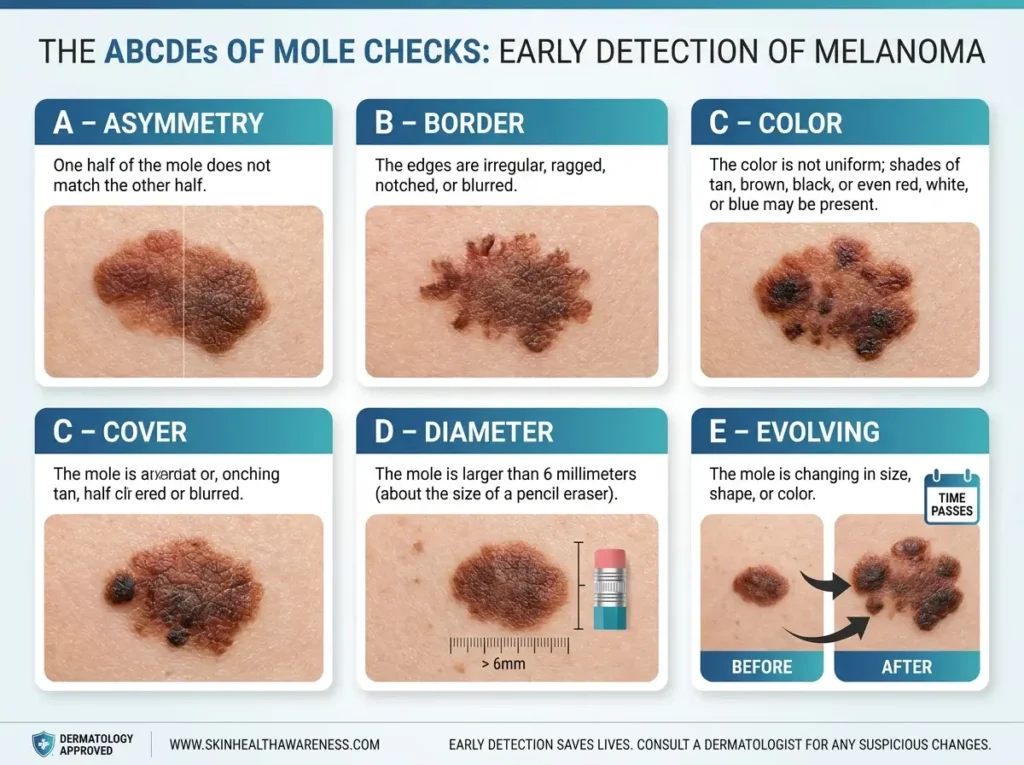
Here’s the part the prettier articles often skip. A beauty mark carries the exact same health considerations as any other mole, so the romantic name shouldn’t lull you into ignoring changes. Most are completely harmless, but it’s worth knowing what to watch for.
Dermatologists use a simple checklist called ABCDE to spot moles that need a closer look:
Asymmetry (A): one half doesn’t match the other.
Border (B): edges look ragged, blurred, or irregular.
Colour (C): more than one shade, or uneven colour across the spot.
Diameter (D): larger than about 6mm — roughly a pencil-eraser.
Evolving (E): any change in size, shape, colour, or new itching, bleeding, or crusting.
Also flag a brand-new mole that appears after age 30, or any mark that simply looks different from your others. When in doubt, get it checked — it’s quick and almost always reassuring. You can read the full criteria straight from the American Academy of Dermatology’s ABCDE guide. And as a baseline habit: wear SPF daily, do a quick self-check once a month, and see a dermatologist once a year for a skin exam.
This kind of awareness fits naturally into any good skincare practice. Whether you’re building a bridal skincare routine before a big day or just leaning into Korean skincare products for a healthy glow, make a habit of actually looking at your skin while you care for it. You’ll notice changes early, and early is everything.
Embracing the Mark You Were Given

It’s funny how a single spot can carry so much — a bit of science, a thread of history, a sprinkle of superstition, and for a lot of people, a quiet sense of identity. Some of the most striking faces in the world are striking precisely because of the little marks that aren’t “perfect.”
So whether you keep yours, draw one on, or decide to have it removed, let it be your call — made with good information and a clear head. Care for your skin, watch for the warning signs, protect it from the sun, and let the rest be exactly what it’s always been: a small, human, beautiful detail.
Want skin that makes every feature look its best? Explore our full
complete skin care routine guide and our favourite everyday beauty tips for a natural glow to build a simple routine that lets your beauty marks — and the rest of you — shine.
Frequently Asked Questions
Are beauty marks the same as moles?
Essentially, yes. A beauty mark is a mole — a cluster of pigment cells — that happens to be small, evenly coloured, and located somewhere flattering, usually the face. All beauty marks are moles, but not every mole gets called a beauty mark.
What do beauty marks mean?
Medically, they mean nothing more than a concentration of melanin in one spot. Culturally and spiritually, they’ve been seen as signs of beauty, good fortune, or destiny, with different meanings attached to where they sit on the face.
Do beauty marks go away on their own?
Usually not. A stable beauty mark tends to stay for life. Slight fading can happen with age or sun protection, but a spot that changes or disappears quickly should be checked by a dermatologist.
Can you remove a beauty mark?
Yes. Dermatologists remove them with shave excision, surgical excision, laser, or freezing. Never attempt removal at home — it risks scarring, infection, and hiding a potentially serious spot.
How much does it cost to remove a beauty mark?
It varies widely. Excisions often run about $100–$500, while laser treatments range from roughly $80 for a tiny spot to $1,000–$3,000 for resurfacing. Cosmetic removal usually isn’t covered by insurance.
Are beauty marks attractive?
Many people think so. From Marilyn Monroe to Cindy Crawford, a well-placed mark has long been seen as a signature feature that adds character and individuality to a face.
Should I be worried about my beauty mark?
Most are harmless, but use the ABCDE rule — watch for asymmetry, irregular borders, uneven colour, size over 6mm, or any change over time. If anything looks off, or a new mole appears after age 30, see a dermatologist.