So, how much do beauty schools cost? Honestly, the answer is not as simple as you would hope. One site says $5,000. The next one says $25,000. Then a school nearby quotes you something in between, plus a kit fee you never saw coming. Understanding how much beauty schools cost upfront saves you from nasty surprises later.
Here is the truth most pages skip. There is no single price tag. Instead, your cost depends on three things: the program you pick, the state you train in, and how your school bills the extras.
Therefore, rather than throwing another vague average at you, this guide breaks down the real, all-in cost. We will cover tuition, your kit, books, and licensing. By the end, you can estimate your own total with confidence. Better still, you will know exactly how to bring it down.
How Much Does Beauty School Cost? The Short Answer
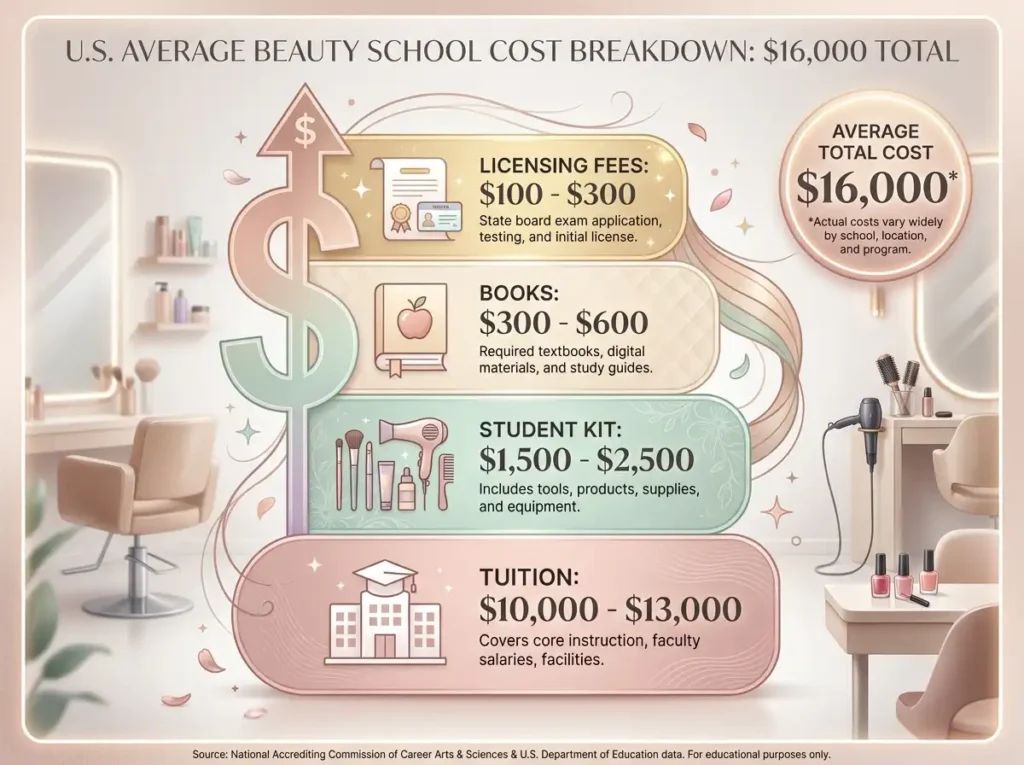
On average, beauty school costs around $16,000 all-in across the U.S. Notably, that figure covers tuition, your student kit, and licensing fees. In other words, it is not just the headline tuition you see on a school’s website.
Still, the realistic range is wide. At the low end, a community college may charge about $5,000. At the high end, a private academy in a big city can reach $25,000. Most programs, however, cost under $20,000 to finish.
Why such a big spread? Three factors drive it: your program type, your state’s required hours, and your choice between a public college and a private school. Let’s unpack each one below.
How Much Beauty School Costs: The Full Breakdown
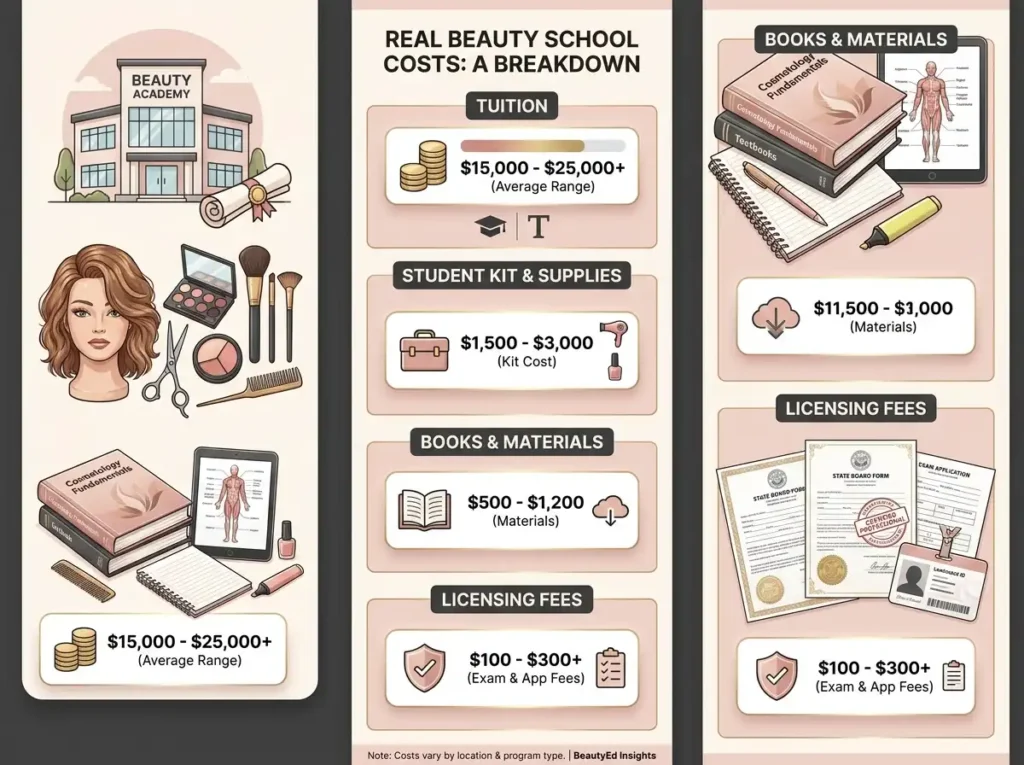
When people ask how much beauty schools cost, tuition is usually what they picture first. First, remember that tuition is only part of the picture. To budget well, you need every line item. So here is what actually makes up the total, including the costs schools tend to mention last.
Tuition: the biggest line item
Naturally, tuition takes the largest share of your money. Moreover, it swings hard depending on the type of school you choose:
• Community colleges: roughly $5,000 to $10,000. This is the most affordable route. However, popular programs sometimes have waitlists.
• Private beauty academies: roughly $15,000 to $25,000. In return, you often get flexible start dates, modern facilities, and smaller classes.
Generally, tuition climbs in larger cities and at well-known academies. By contrast, it tends to sit lower in the Midwest and rural areas.
Student kit and supplies
Your kit is the box of professional tools you train and test with. For instance, it includes shears, clippers, brushes, mannequin heads, and styling products. Typically, you will pay $1,200 to $2,500, depending on what is inside.
Some schools fold the kit into tuition. Others bill it separately. Unfortunately, that is exactly the kind of surprise that wrecks a budget. So always ask which it is before you enroll.
Books and materials
Next come textbooks, workbooks, and sometimes a tablet. Usually, these add a few hundred dollars. Occasionally, schools roll them into tuition. Either way, confirm it upfront.
Licensing and state board exam fees
Finally, once you finish training, you pay to sit your state board exam and to get your license. In most states, this runs $100 to $300 combined. States with longer practical exams may sit at the top of that range.
Also, watch out for one hidden cost: exam retakes. If you do not pass the first time, you pay again. That is why solid exam prep is money well spent.
| Cost component | Typical range | Notes |
| Tuition | $5,000 – $25,000 | Biggest variable; depends on school type and state |
| Student kit & supplies | $1,200 – $2,500 | Sometimes included in tuition |
| Books & materials | $200 – $500 | Occasionally bundled |
| Licensing & exam fees | $100 – $300 | Plus retake fees if needed |
| Typical all-in total | ~$16,000 average | Range: ~$5,000 to ~$25,000+ |
Figures reflect 2025–2026 U.S. averages. Because fees change often, always confirm with the school and your state board.
How much Beauty School Cost by Program: Cosmetology, Esthetics, Nails, Barbering
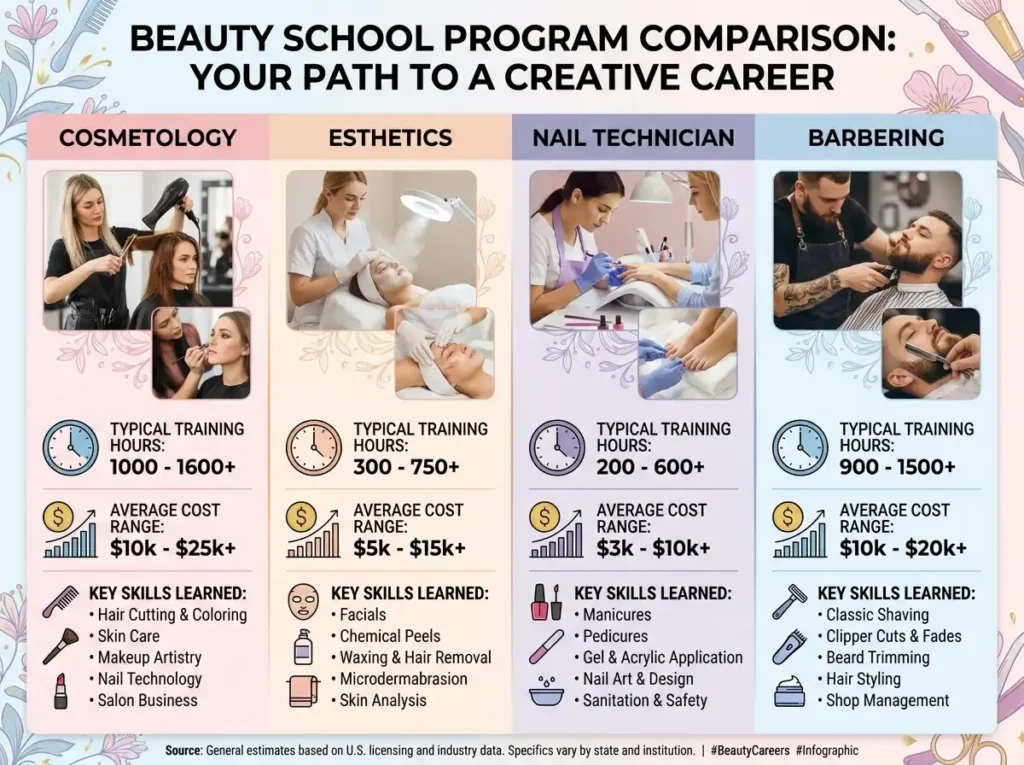
Keep in mind that “beauty school” is an umbrella term. Consequently, the program you choose changes both your cost and your timeline. After all, each license requires a different number of hours.
Cosmetology program cost
Cosmetology is the broadest license, covering hair, skin, and nails. As a result, it is the most popular choice. It is also the longest program, which makes it the priciest. Typically, full programs run $10,000 to $21,000 at private schools, and less at community colleges.
Esthetics program cost
Esthetics focuses on skincare, such as facials, exfoliation, and treatments. Because it is shorter, often around 600 hours, it usually costs less. Frequently, you will spend $9,000 to $11,500. So if your interest leans toward skin health, this is a smart, affordable pick.
Curious about skin treatments first? Our guide on how long microblading lasts shows what semi-permanent beauty work actually involves.
Nail technician program cost
Nail tech is the shortest and cheapest path. In fact, hour requirements often sit between 250 and 600. Therefore, programs frequently cost well under $5,000. For many students, this is the fastest way into the industry.
Want a feel for the craft? See our breakdown of what a pedicure involves and the most popular almond-shape nail styles clients request.
Barbering program cost
Barbering centers on cutting, shaving, and grooming. In many states, costs match cosmetology, often $15,000 to $20,000 at private schools. However, hour requirements are sometimes lower, which can shorten your timeline and trim your bill.
Why Beauty School Costs More in Some States
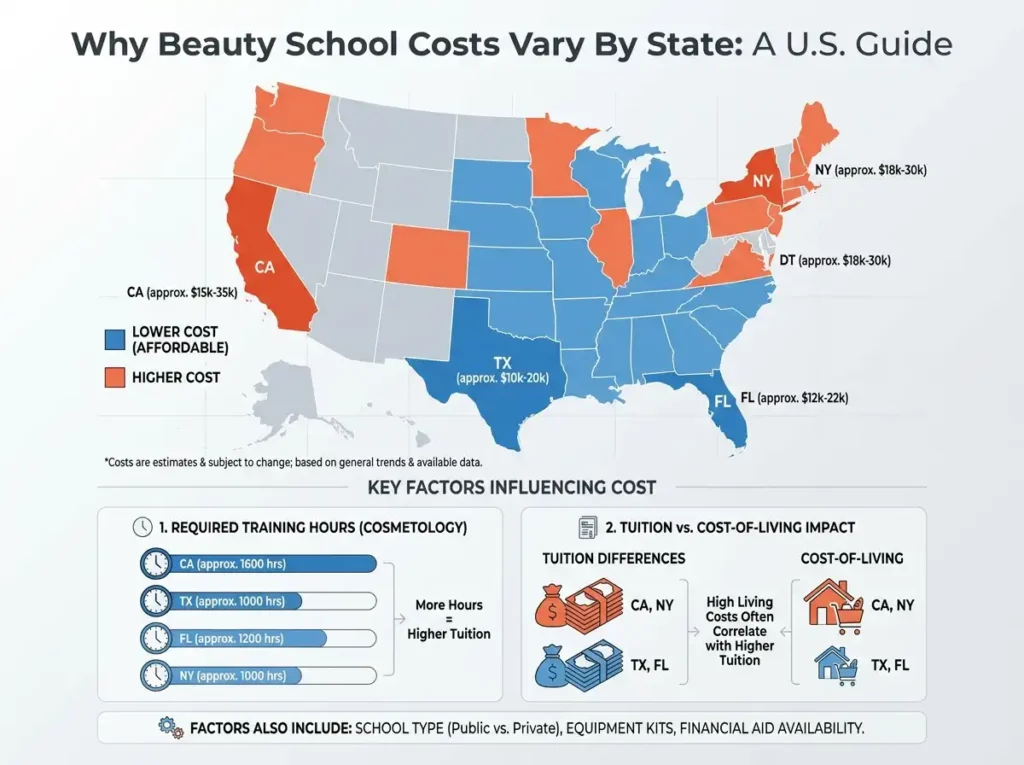
Here is the connection most cost articles miss completely. Simply put, your tuition is tied directly to how many training hours your state requires. More required hours means more class time. In turn, more class time means a higher bill. This is the real reason how much beauty schools cost varies so widely from state to state.
How required training hours affect price
Across the country, required cosmetology hours range from about 1,000 to 2,100. Therefore, a state that mandates 1,000 hours costs less to complete than one demanding 1,600. The school quality can be identical. Yet the price differs purely because of time.
This is exactly why “how much is beauty school” has no universal answer. Indeed, two students at equally good schools can pay thousands apart, simply based on where they live.
| State | Cosmetology hours | Cost impact |
| New York | 1,000 hours | Lower hour load — shorter and often cheaper |
| Florida | 1,200 hours | Mid-range hours and tuition |
| Texas | 1,000 hours | Recently reduced — faster path to licensure |
| California | 1,000 hours | High living costs offset the lower hour count |
| Massachusetts | 1,000 hours | Practical exam dropped; written only |
Hour requirements change as states deregulate. So always verify your state’s current rule with its cosmetology board before enrolling.
The 2026 deregulation trend
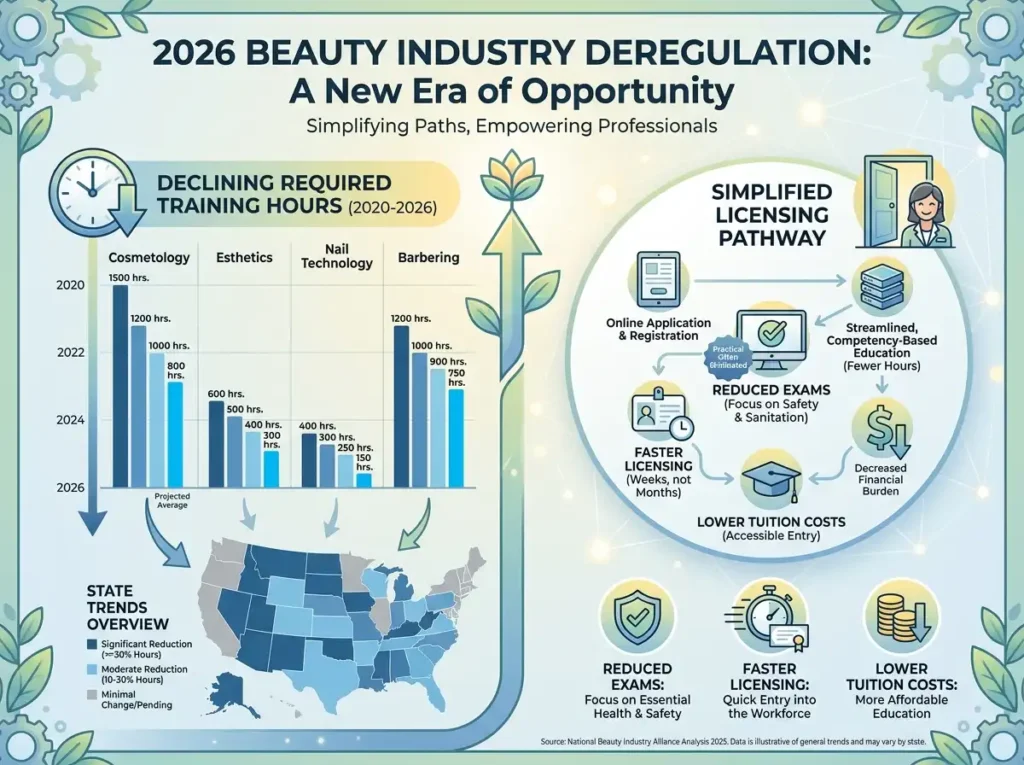
Fortunately, there is good news if you are starting now. Across the U.S., a clear push is reducing required hours. Several states have trimmed their minimums. In addition, a few — including California, Massachusetts, and Mississippi — have dropped the hands-on practical exam entirely.
As a result, fewer required hours mean a lower total cost and a faster route to earning. Moreover, the trend looks set to continue. For new students, the timing is genuinely favorable.
High-cost vs affordable states
As a rule of thumb, high-cost-of-living states like California, New York, and parts of Florida sit at the pricier end. Meanwhile, Midwest states such as Ohio and Missouri tend to offer more affordable programs. In some cases, rural community colleges still run full certificates for around $5,000 total.
How Long Does Beauty School Take?
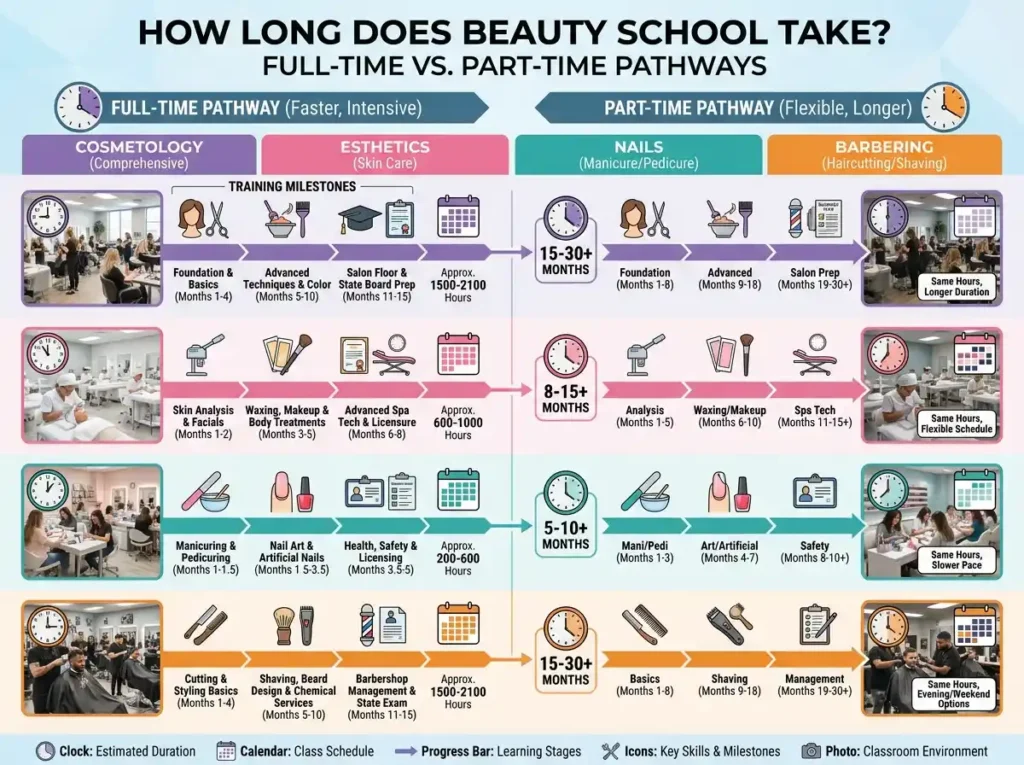
Since cost and time go hand in hand, let’s answer the other big question. Namely, how long is beauty school, really?
Program length: full-time vs part-time
Typically, most cosmetology programs run 1,000 to 1,600 hours. Full-time, that works out to roughly 9 to 15 months. Part-time, while you work or raise a family, it can stretch to about two years.
Meanwhile, shorter specialties move faster. For example, esthetics and nail programs can wrap in a few months. As a result, you get licensed and earning sooner.
Hours required by state
As noted above, your state sets the clock. So always check your specific requirement first. Ultimately, it determines both how long you stay in school and how much you pay.
What you actually do in beauty school
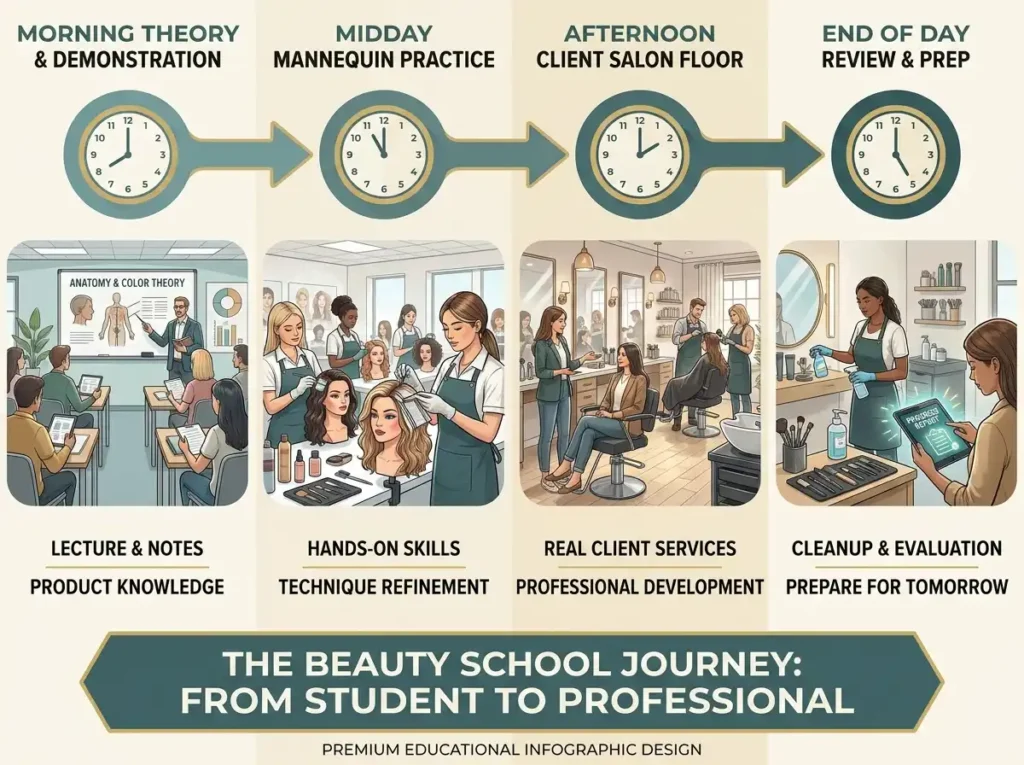
Wondering what a school day looks like? Generally, mornings start with theory: anatomy, sanitation, product science, and state law. Then afternoons shift to hands-on practice. At first, you work on mannequins. Later, you serve real clients in the school’s student salon.
Importantly, that client-floor time is the heart of the program. There, you build speed, confidence, and the portfolio that lands your first job.
How to Pay for Beauty School
Once you know how much beauty schools cost, the next worry is paying for it. Often, the sticker price scares people off before they see how much help exists. So here is how most students actually fund their training. In short, you have more options than you think.
Federal financial aid and FAFSA
If your school is accredited, you can file the FAFSA and tap federal grants and student loans. In fact, it is the same system used for traditional college. However, accreditation is the key word here. Without it, federal aid is off the table. So confirm a school’s status before you commit.
Scholarships and workforce grants
Surprisingly, beauty-specific scholarships are more common than people expect. For instance, programs like Beauty Changes Lives offer awards worth several thousand dollars. Likewise, brands such as Aveda run their own. On top of that, many states provide WIOA workforce grants for career training.
• First, check your state’s department of education or workforce site for grants.
• Next, ask each school’s financial aid office about institutional scholarships.
• Finally, look into industry awards from beauty nonprofits and product brands.
Payment plans and institutional aid
In addition, most private academies offer monthly payment plans. As a result, you are not paying everything upfront. Many also have their own need-based scholarships. Typically, the average private-school student receives a few thousand dollars in aid. So always ask what is available, rather than assuming full price.
Is the Cost of Beauty School Worth It ?
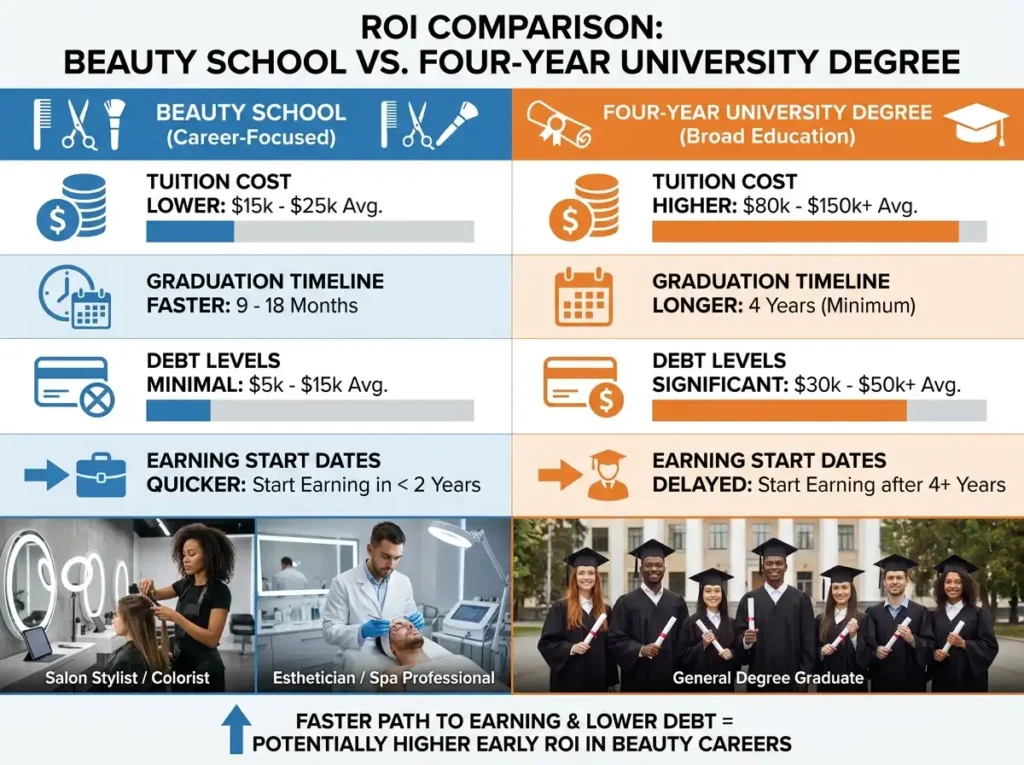
So is the cost worth it? Let’s weigh how much beauty schools cost against what you’ll earn. Naturally, this is a fair question for any investment. In short, for many people the answer is yes. Still, it depends on your goals and how you build your career.
Cosmetologist salary and earning potential
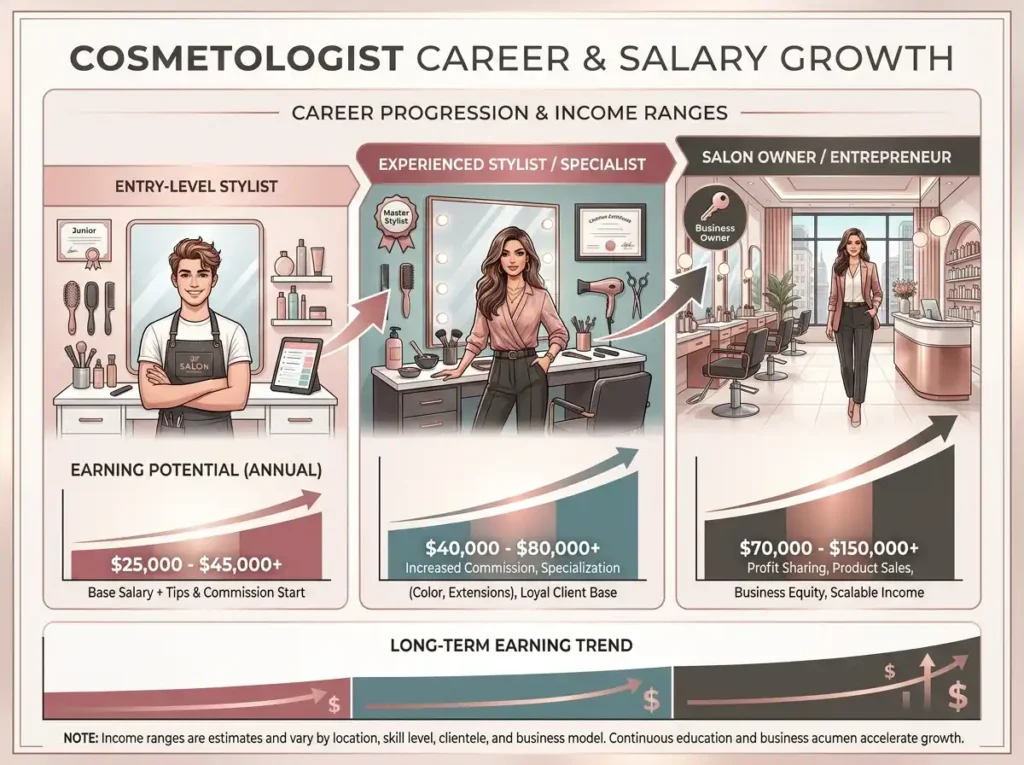
Admittedly, entry-level pay is modest. According to the U.S. Bureau of Labor Statistics, the median annual wage for hairdressers, hairstylists, and cosmetologists is about $34,970. However, earning potential climbs fast with skill and clientele. In fact, the top 10% of earners make over $63,000.
Beyond that, experienced stylists in high-end salons earn far more. The same goes for those who build a loyal book or open their own business. Often, they reach $60,000 to $100,000 or more. Clearly, the ceiling in beauty depends more on your reputation than on your starting salary.
Beauty school vs a four-year degree
Now, put the numbers side by side. Beauty school tops out around $25,000 all-in, and often much less. By comparison, the average four-year degree runs roughly $63,780 in tuition alone. And that is before books, housing, or years of lost earnings.
On top of that, you finish beauty school in months, not years. Therefore, you start earning while your peers are still in lecture halls.
| Beauty school | Four-year degree | |
| Typical cost | ~$5,000–$25,000 all-in | ~$63,780 tuition alone |
| Time to finish | Months to ~2 years | 4 years |
| Start earning | Right after licensure | After graduation |
ROI by career path
Ultimately, the return depends on where you take it. For example, a stylist who rents a chair and builds a steady clientele recoups tuition quickly. Meanwhile, a salon owner or educator can multiply it many times over. By contrast, a part-time nail tech earns less, but also invested far less to begin with. In the end, there is no single payback timeline. There is only the one you build.
Thinking long term? Our guide to everyday beauty tips can help you build the personal brand that grows your income.
How to Lower Your Beauty School Costs
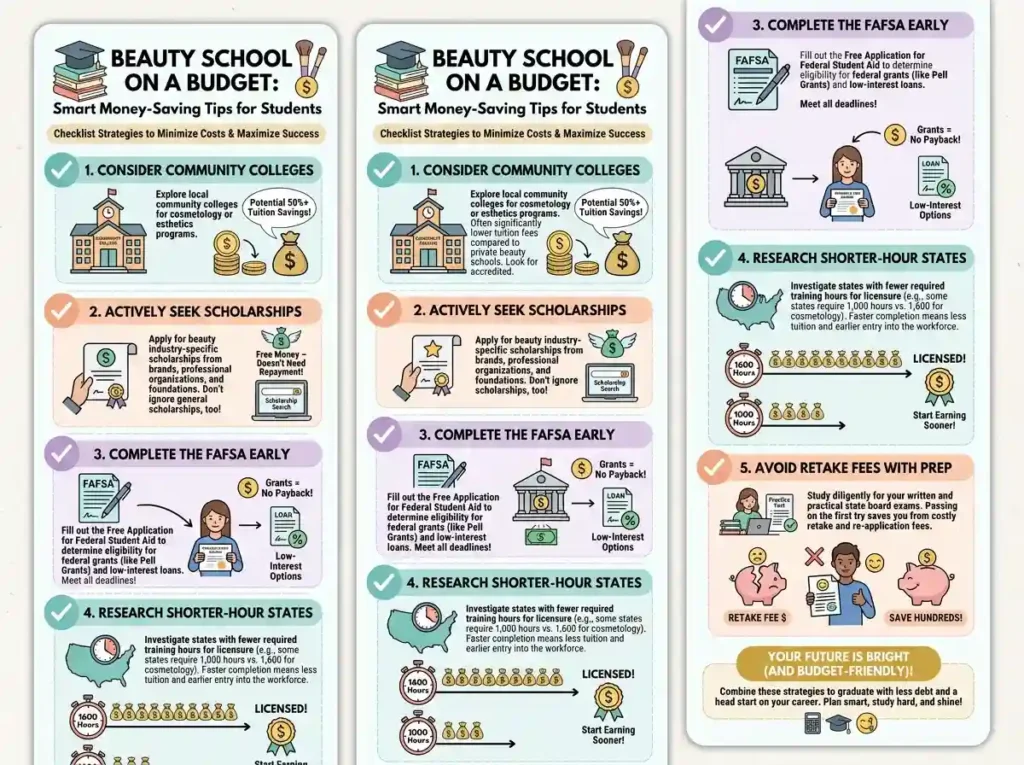
If money is tight, you have more levers to pull than you might think. In fact, a few smart moves can cut your total significantly:
• First, start at a community college. Public programs are often half the price of private academies.
• Second, pick an accredited school so you qualify for FAFSA and federal aid.
• Third, apply early for scholarships and WIOA grants. Many go unclaimed.
• Also, compare total hours, not just tuition. A “cheaper” school that requires more hours can cost more overall.
• Likewise, ask whether the kit and exam fees are included before signing.
• Finally, invest in exam prep so you avoid paying for retakes.
Frequently Asked Questions
How much do beauty school cost on average?
On average, beauty school costs around $16,000 total in the U.S. That figure includes tuition, kit, and licensing. However, it ranges from about $5,000 at community colleges to $25,000 at private academies.
Why is beauty school cheaper at community colleges?
Mainly, lower overhead and public funding keep tuition down, often $5,000 to $10,000. The trade-off is that popular programs may have waitlists.
Does the cost include the kit and licensing?
Often, no. So plan for an extra $1,200 to $2,500 for your kit, plus $100 to $300 for licensing and exam fees, unless the school states they are included.
How long does beauty school take?
Generally, most cosmetology programs run 1,000 to 1,600 hours. That means roughly 9 to 15 months full-time, or up to two years part-time. Esthetics and nail programs are shorter.
Can I get financial aid for beauty school?
Yes. If the school is accredited, you can use FAFSA for federal aid. In addition, you may qualify for state WIOA workforce grants and private beauty scholarships.
Is beauty school worth the money?
For many people, yes. After all, the total cost is a fraction of a four-year degree. Moreover, experienced stylists or salon owners can earn well above the median.
What is the cheapest way to become a cosmetologist?
First, choose an accredited community college program. Then apply for grants and scholarships. Finally, if you can relocate, pick a state with lower required hours.
The Bottom Line on Beauty School Costs
So, how much do beauty schools cost? As a national benchmark, plan for around $16,000 all-in. Realistically, though, your number could land anywhere from $5,000 to $25,000. It all depends on your program, your state, and your school.
Above all, do not just chase the lowest sticker price. Instead, get a full written breakdown from a few accredited schools. Then weigh it against your earning goals. Do that, and your investment stops being a guess. Finally, it becomes a real plan.
Want to keep exploring? Browse more on building a daily skincare routine and the trending nail colors clients are asking for right now.